
Chieut (ㅊ) – Korean Consonant 치읓
ㅊ (Chieut, 치읓) is a strongly puffed ch that is read as a short t at the end of a syllable. See 치즈 and 친구, trace ㅊ in 3 strokes, print the ㅊ worksheet.
What is Chieut (ㅊ) in Korean?
Chieut (ㅊ) is called 치읓 in Korean and is a strongly puffed ch that is read as a short t at the end of a syllable. ㅊ is one of the 14 basic consonants, takes 3 strokes to write and is made with the teeth ridge. You can hear it in 치즈 (cheese) and 친구 (friend), and see it closing a syllable in 꽃 (flower).
Chieut ㅊ: sound, strokes, series and finals
ㅊ ChieutKorean consonant · basic
Chieut is ch at the start of a syllable and t at the end.
Chieut (ㅊ) at a glance
Three ways to remember ㅊ
 Shape
 Words that start with

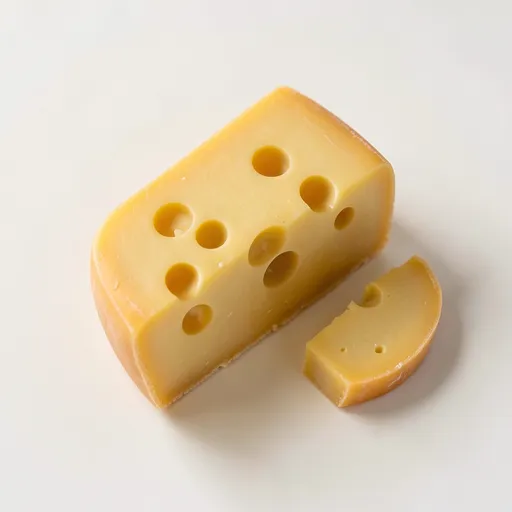
Words with ㅊ at the end
 flower
More words with ㅊ
Sound: t.
How to say ㅊ
치읓How ㅊ ends a syllable
Final ㅊ (chieut) sounds the same as several other letters, because Korean keeps only one stop of this kind at the end of a block. 꽃 (flower) ends in that quiet t, while 꽃이 reveals the hidden letter as [꼬치].
You see ㅊ (chieut) at the bottom of the block, yet your mouth makes ㄷ (digeut), and that gap explains most reading surprises with ㅊ.
How to write ㅊ
Trace Chieut ㅊ with a finger, mouse or pen: start at the numbered dot, follow the dotted arrow, and press Clear to try again.
Print style 정자체
Follow the numbers and dotted arrows
Handwriting 필기체
Same stroke order as print style
A short tick at the top, drawn downward.
Below it, a short line to the right that sweeps down to the lower left.
From the middle of the second stroke, sweep down to the lower right.
ㅊ (chieut) takes three strokes in total, written from top to bottom and left to right.
In some fonts the top of ㅊ is a short flat line, in handwriting a small tick; both are correct. Practice 친구, 책 (book) and 차 to build the breathy start.
ㅊ and its look-alikes
Why ㅊ looks the way it does
ㅊ sounds harsher than ㅈ (jieut), so one stroke was added to ㅈ. The small tick on top is the added stroke.
ㅊ (chieut) sits in the group that uses the teeth ridge, since the inventors of Hangul sorted consonants by where the sound is made.
Words that use ㅊ
| Word | Reading | Meaning |
|---|---|---|
| 차례 | cha-rye | turn (noun) |
| 차이 | cha-i | difference (noun) |
| 차표 | cha-pyo | ticket (noun) |
| 최고 | choe-go | the best (noun) |
The first block of 치즈 (cheese) is 치, and it opens with ㅊ: read chi.
The first block of 친구 (friend) is 친, and it opens with ㅊ: read chin.
The first block of 차 (tea; car) is 차, and it opens with ㅊ: read cha.
The first block of 침대 (bed) is 침, and it opens with ㅊ: read chim.
Look for ㅊ at the front of 초 in 초콜릿 (chocolate); the block is read cho.
Syllables you can build with ㅊ
With ㅊ (chieut) in front, the vowels give blocks like 차 (cha), 챠 (chya), 처 (cheo), and 쳐 (chyeo).
The ten blocks 차 (cha), 챠 (chya), 처 (cheo), 쳐 (chyeo), 초 (cho), 쵸 (chyo), 추 (chu), 츄 (chyu), 츠 (cheu), 치 (chi) are worth reading in one breath.
Try it yourself

Pick a vowel and a final for ㅊ and read the block it makes. Open the syllable builder with ㅊ ready
ㅊ writing worksheet (free printable)
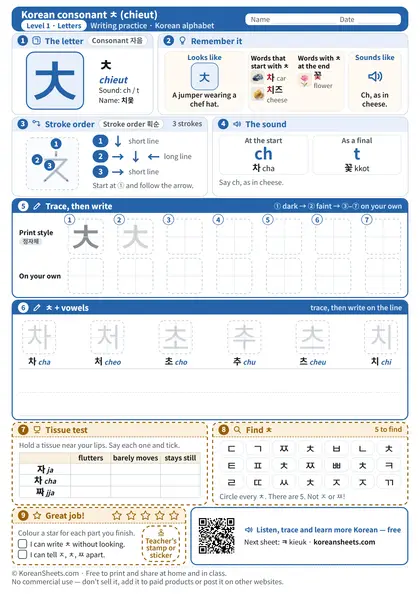
Worksheet · Level 1 · Letters
Korean letter tracing worksheet: ㅊ (chieut)
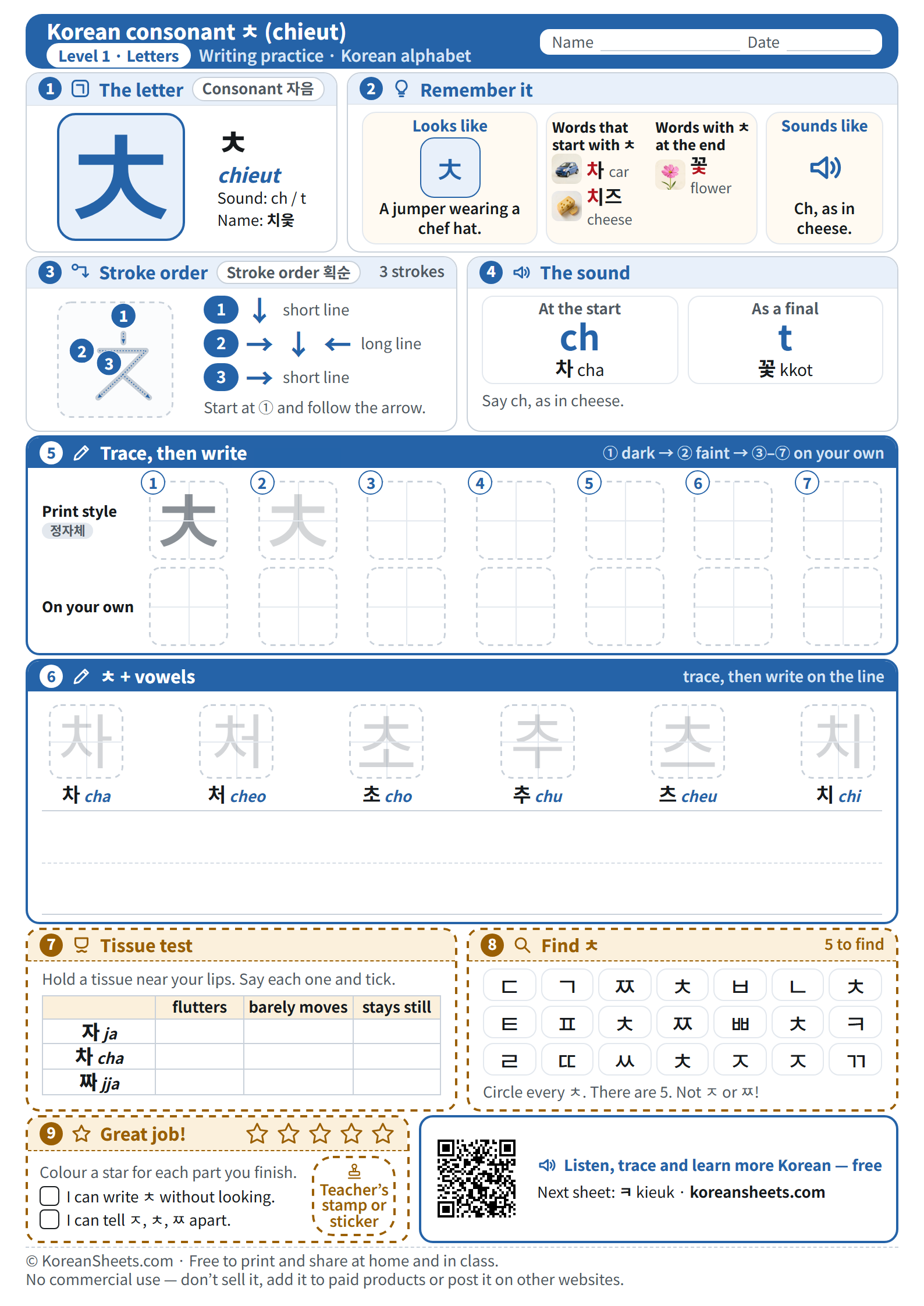
The one-page Chieut ㅊ sheet shows ㅊ in 3 strokes, traces it, writes it with six vowels (차 처 초 추 츠 치) and ends with a game of finding ㅊ among look-alikes.
- 1 page
- A4 · US Letter
- PDF · 104 KB
- Free · no sign-up
Want more? Get all 19 consonants in one pack
Worksheet information
- How to use
- Say ㅊ out loud, trace its 3 strokes, then write it with six vowels.
Practice ㅊ
Try it yourself
Put Chieut ㅊ, ch, into the builder and read the block it makes. Open the syllable builder with ㅊ ready
ㅊ (Chieut) — FAQ
What should the ㅊ pronunciation sound like?
Read it as a strongly puffed ch that is read as a short t at the end of a syllable; 치즈 (cheese) is a good word to practice with.
What is ㅊ called in Korean and what sound does it make?
Koreans call ㅊ 치읓 (chieut). The sound: a strongly puffed ch that is read as a short t at the end of a syllable, heard in 치즈 and 꽃.
How many strokes does ㅊ have?
ㅊ (chieut) has 3 strokes: a short tick on top, then the ㅈ shape in two strokes.
Last updated: