
Korean Consonants: 19 Letters with Sounds and Names
Korean consonants explained: the chart of 19 letters with names, start and end sounds, plain, aspirated and tense sets, and the eleven double finals.
What are the Korean consonants?
Korean has 19 consonants: 14 basic letters and 5 double (tense) letters, written ㄱ ㄴ ㄷ ㄹ ㅁ ㅂ ㅅ ㅇ ㅈ ㅊ ㅋ ㅌ ㅍ ㅎ and ㄲ ㄸ ㅃ ㅆ ㅉ. Most come in sets of three strengths, light, strongly puffed and tight, and each one has a single page with its sound, stroke order and a free worksheet.
Korean consonants: counts and where to go next
Korean consonants
Korean consonants
Korean consonant chart
| Letter | Name | Start | End | Strokes |
|---|---|---|---|---|
| ㄱ | 기역 (giyeok) | g | k | 1 |
| ㄲ | 쌍기역 (ssanggiyeok) | kk | k | 2 |
| ㄴ | 니은 (nieun) | n | n | 1 |
| ㄷ | 디귿 (digeut) | d | t | 2 |
| ㄸ | 쌍디귿 (ssangdigeut) | tt | — | 4 |
| ㄹ | 리을 (rieul) | r | l | 3 |
| ㅁ | 미음 (mieum) | m | m | 3 |
| ㅂ | 비읍 (bieup) | b | p | 4 |
| ㅃ | 쌍비읍 (ssangbieup) | pp | — | 8 |
| ㅅ | 시옷 (siot) | s | t | 2 |
| ㅆ | 쌍시옷 (ssangsiot) | ss | t | 4 |
| ㅇ | 이응 (ieung) | silent | ng | 1 |
| ㅈ | 지읒 (jieut) | j | t | 2 |
| ㅉ | 쌍지읒 (ssangjieut) | jj | — | 4 |
| ㅊ | 치읓 (chieut) | ch | t | 3 |
| ㅋ | 키읔 (kieuk) | k | k | 2 |
| ㅌ | 티읕 (tieut) | t | t | 3 |
| ㅍ | 피읖 (pieup) | p | p | 4 |
| ㅎ | 히읗 (hieut) | h | t | 3 |
The table lists every consonant with its name, its sound at the start of a block and its sound at the end. Tap a letter to open its page.
Free printable worksheet sets for the consonants
Ready-to-print packs for the consonants, then one tracing worksheet for every letter. Flip through the pages first, then download the PDF for your paper size.
Pack · Level 1 · Letters
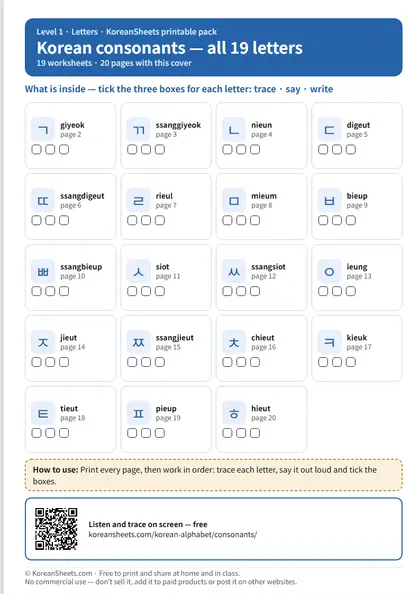
Korean consonants worksheet: all 19 letters
Trace, say and write every consonant from ㄱ to ㅎ, one letter per page.
- 20 pages
- A4 · US Letter
- PDF · 1.5 MB
- Free · no sign-up
After printing: hear every consonant on the consonants page
Worksheet information
- For
- Complete beginners of any age
- Inside
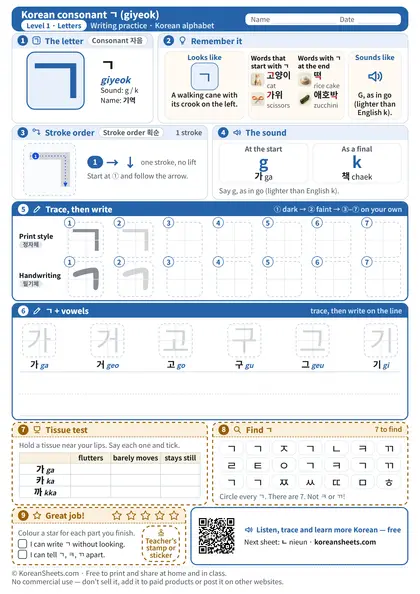
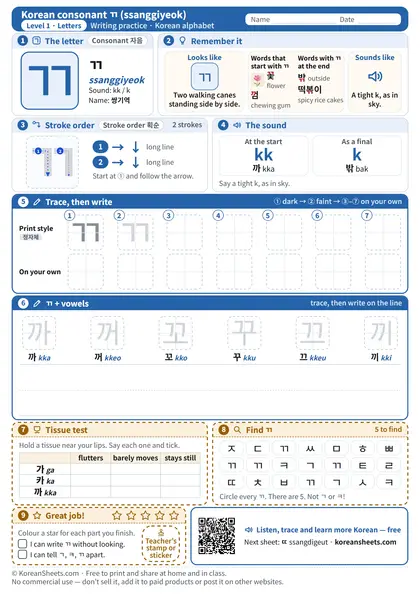
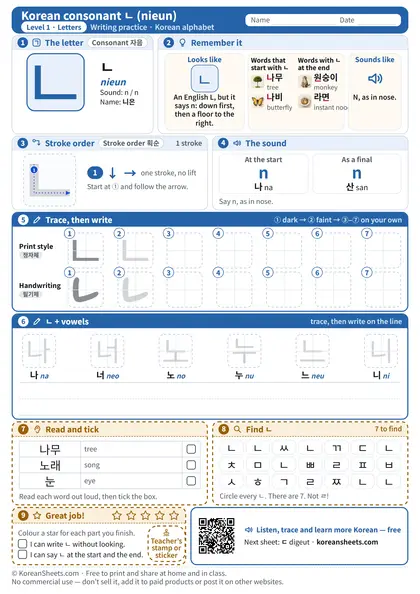
- A cover with a tick list, then 19 one-page tracing worksheets: stroke order, tracing, syllables and a find-the-letter game
- How to use
- Print every page, then work in order: trace each letter, say it out loud and tick the boxes.
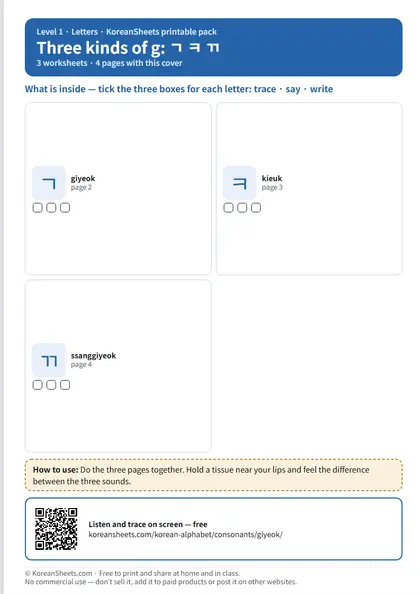
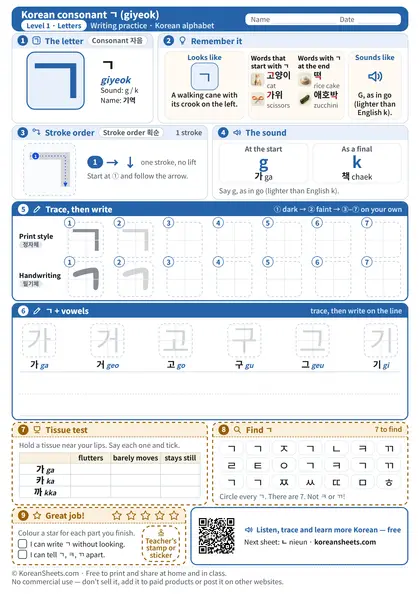
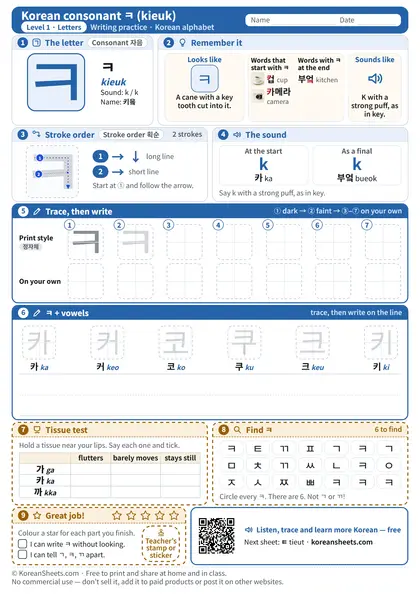
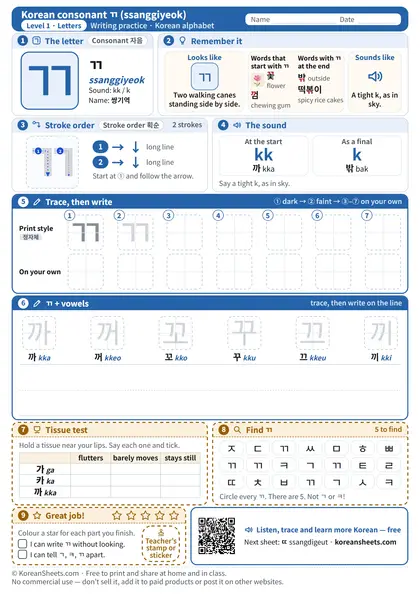
Pack · Level 1 · Letters
Korean alphabet tracing worksheet: the three g sounds ㄱ ㅋ ㄲ
Hear and write the plain, breathy and tense g side by side.
- 4 pages
- A4 · US Letter
- PDF · 334 KB
- Free · no sign-up
After printing: listen to ㄱ ㅋ ㄲ on the giyeok page
Worksheet information
- For
- Complete beginners of any age
- Inside
- A cover with a tick list, then 3 one-page tracing worksheets for the three g sounds
- How to use
- Do the three pages together. Hold a tissue near your lips and feel the difference between the three sounds.
Korean consonants by place in the mouth
Made with the throat: ㅇ ㅎ.
Plain, aspirated and tense consonants
| Plain | Aspirated | Tense | Word set |
|---|---|---|---|
| ㄷ | ㅌ | ㄸ | 달 (moon), 탈 (mask), 딸 (daughter) |
| ㅂ | ㅍ | ㅃ | 불 (fire; light), 풀 (grass), 뿔 (horn) |
| ㅈ | ㅊ | ㅉ | 자다 (to sleep), 차다 (to kick; to be cold), 짜다 (to be salty) |
| ㅅ | — | ㅆ | 살 (flesh; age), 쌀 (uncooked rice) |
Four places in the mouth each have three consonants that differ only in strength: a plain letter with a light breath, an aspirated letter with a strong puff, and a tense letter that is tight with no puff.
ㄱ, ㅋ, ㄲ: compare 가 (ga), 카 (ka) and 까 (kka).
ㄷ, ㅌ, ㄸ: compare 다 (da), 타 (ta) and 따 (tta).
Korean double consonants
The five double consonants, ㄲ, ㄸ, ㅃ, ㅆ and ㅉ, are written by doubling a plain consonant and are pronounced tight, with no puff of air. Only ㄲ and ㅆ can close a syllable; ㄸ, ㅃ and ㅉ appear only at the start of a block.
Learners often hear the double consonants as simply “harder”. A better picture is that the throat is tense before the sound starts, as in the k of “sky”.
Korean consonant names
Each name uses the letter at both ends: the first syllable begins with the letter and the second ends with it. The names are 기역, 쌍기역, 니은, 디귿, 쌍디귿, 리을, 미음, 비읍, 쌍비읍, 시옷, 쌍시옷, 이응, 지읒, 쌍지읒, 치읓, 키읔, 티읕, 피읖, and 히읗.
Korean consonant pronunciation at the end of a syllable
Hear the pattern in 책 (book) [책], 밖 (outside) [박], 옷 (clothes) [옫], 꽃 (flower) [꼳], and 앞 (front) [압].
Double final consonants
Telling similar consonants apart
Three groups cause most of the trouble, because plain, puffed and tight sounds share one place in the mouth. Hold a thin strip of paper in front of your lips: ㅋ, ㅌ, ㅍ and ㅊ blow it away with a strong puff, ㄲ, ㄸ, ㅃ and ㅉ keep the air in with a tight throat, and the plain ㄱ, ㄷ, ㅂ and ㅈ move it only a little.
Try it in the syllable builder
Try it yourself

Build a block with ㄱ and ㅏ and see how it is read. Open the syllable builder with ㄱ and ㅏ ready
Korean consonants FAQ
How to pronounce Korean consonants?
Say each consonant with a vowel behind it, such as 가 and 나, and learn that many have a light, a puffed and a tight version. At the end of a block they shrink to seven sounds: k, n, t, l, m, p and ng.
What are Korean tense consonants?
The Korean tense consonants are ㄲ, ㄸ, ㅃ, ㅆ and ㅉ. They are pronounced with a tight throat and no puff of air, like the k of “sky”.
What are Korean aspirated consonants?
The Korean aspirated consonants are ㅋ, ㅌ, ㅍ and ㅊ, and ㅎ is breathy too. Each is released with a clear puff of air that you can feel on your hand.
Where can I find the Korean consonant chart?
The chart at the top of this page lists all 19 consonants with their names, start and end sounds, and stroke counts. Each row links to a page with a worksheet.
Last updated: