
Ssang Digeut (ㄸ) – Korean Consonant 쌍디귿
ㄸ (Ssang Digeut, 쌍디귿) is a tight tt that never closes a syllable. See 떡 and 뚜껑 as example words, trace ㄸ in 4 strokes, print the ㄸ worksheet for free.
What is Ssang Digeut (ㄸ) in Korean?
Ssang Digeut (ㄸ) is called 쌍디귿 in Korean and is a tight tt that never closes a syllable. Write ㄸ in 4 strokes; the sound is made with the tip of the tongue, and it counts as a double consonant, written as ㄷ twice. You will meet it in 떡 (rice cake) and 뚜껑 (lid); because it never ends a syllable, it appears only at the start of a block.
Ssang Digeut ㄸ: sound, strokes, series and finals
ㄸ Ssang DigeutKorean consonant · double
Ssang Digeut is tt at the start of a syllable and null at the end.
Ssang Digeut (ㄸ) at a glance
| Fact | Value |
|---|---|
| Name | 쌍디귿 (ssangdigeut) |
| Sound at the start | tt — a tight throat and no puff of air |
| Sound at the end | not used as a final consonant |
| Strokes | 4 |
| Group | double consonant |
| Made with | the tip of the tongue |
| Example words | 떡 (rice cake), 땀 (sweat) |
Two ways to remember ㄸ
 Shape
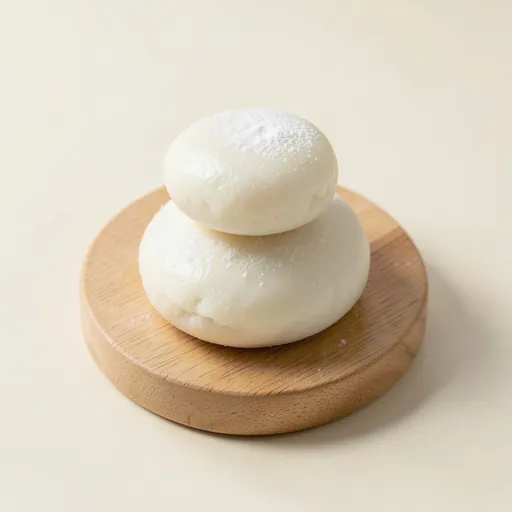
 Words that start with
How to say ㄸ
쌍디귿ㄸ is a tense t: press the tongue tip firmly behind the upper teeth, tighten the throat and release with no breath. It is close to the t in English 'stop'.
ㄸ appears only at the start of a syllable and is romanized tt, as in 딸 (ttal, daughter). With ㄸ (ssangdigeut), it is never written as a 받침.
ㄸ only at the start
ㄸ is never written under a vowel. Because the sound is tight and quick, Korean spelling keeps it for the start of a syllable, so there is no final form to learn.
ㄸ also has a plain partner, ㄷ (digeut), which can sit at the end of a syllable when ㄸ cannot.
How to write ㄸ
Trace Ssang Digeut ㄸ with a finger, mouse or pen: start at the numbered dot, follow the dotted arrow, and press Clear to try again.
Print style 정자체
Follow the numbers and dotted arrows
Handwriting 필기체
Same stroke order as print style
Draw a short top line on the left half.
Under it, go down and turn right to close the left ㄷ.
Draw the top line of the right ㄷ.
Go down and turn right to finish the second ㄷ.
ㄸ (ssangdigeut) takes four strokes in total, written from top to bottom and left to right.
Say 또 (again) quickly several times. The tongue should hit the same spot each time and the vowel should start high and sharp. Then try 떡 (rice cake) and 딸기 (strawberry).
ㄸ and its look-alikes
딸 (daughter) and 탈 (mask) differ only in breath: 탈 lets out air, 딸 does not. 달 (moon) sits in between with a light, relaxed start.
Some learners add a breath after ㄸ because it looks like two letters. The doubling means tighter, not louder; keep the air in.
Why ㄸ looks the way it does
ㄸ (ssangdigeut) stands for a sound made with the tip of the tongue, because Hangul's consonant shapes follow the mouth.
Words that use ㄸ
| Word | Reading | Meaning |
|---|---|---|
| 뚜껑 | ttu-kkeong | lid (noun) |
| 딸 | ttal | daughter (noun) |
| 떡볶이 | [떡뽀끼] tteok-ppo-kki | spicy rice cakes (noun) |
The first block of 떡 (rice cake) is 떡, and it opens with ㄸ: read tteok.
The first block of 뚜껑 (lid) is 뚜, and it opens with ㄸ: read ttu.
The first block of 땀 (sweat) is 땀, and it opens with ㄸ: read ttam.
The first block of 딸기 (strawberry) is 딸, and it opens with ㄸ: read ttal.
The first block of 뚱뚱하다 (to be fat) is 뚱, and it opens with ㄸ: read ttung.
Syllables you can build with ㄸ
With ㄸ (ssangdigeut) in front, the vowels give blocks like 따 (tta), 땨 (ttya), 떠 (tteo), and 뗘 (ttyeo).
Say the whole row, 따 (tta), 땨 (ttya), 떠 (tteo), 뗘 (ttyeo), 또 (tto), 뚀 (ttyo), 뚜 (ttu), 뜌 (ttyu), 뜨 (tteu), 띠 (tti), and notice that only the vowel moves.
Try it yourself

Pick a vowel and a final for ㄸ and read the block it makes. Open the syllable builder with ㄸ ready
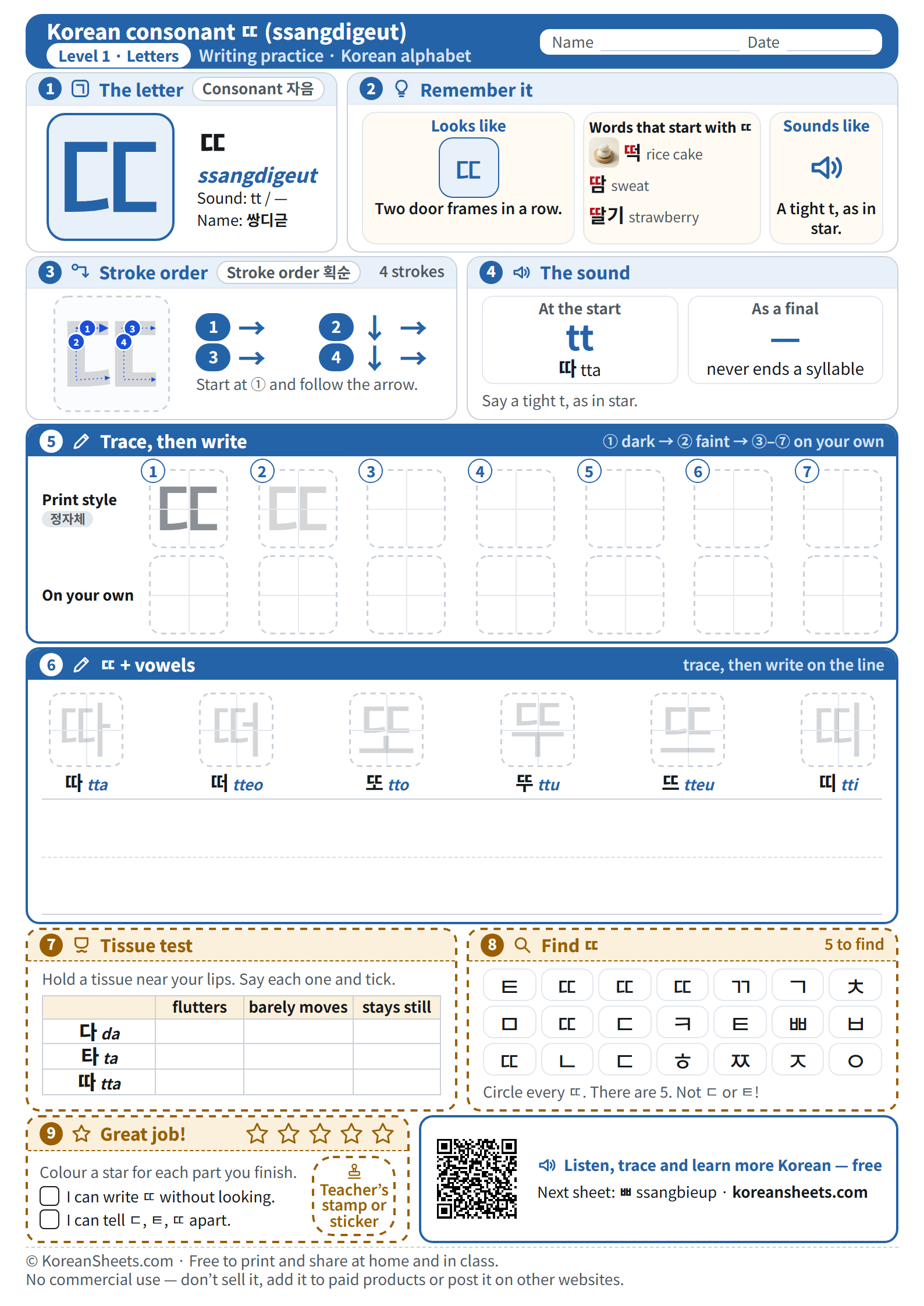
ㄸ writing worksheet (free printable)
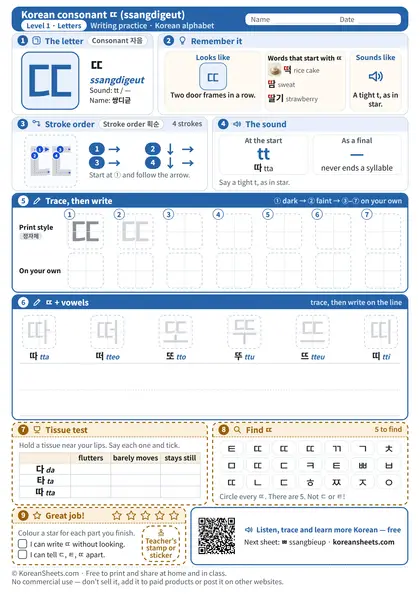
Worksheet · Level 1 · Letters
Korean letter tracing worksheet: ㄸ (ssangdigeut)
The one-page Ssang Digeut ㄸ sheet shows ㄸ in 4 strokes, traces it, writes it with six vowels (따 떠 또 뚜 뜨 띠) and ends with a game of finding ㄸ among look-alikes.
- 1 page
- A4 · US Letter
- PDF · 91 KB
- Free · no sign-up
Want more? Get all 19 consonants in one pack
Worksheet information
- How to use
- Say ㄸ out loud, trace its 4 strokes, then write it with six vowels.
Practice ㄸ
Try it yourself
Put Ssang Digeut ㄸ, tt, into the builder and read the block it makes. Open the syllable builder with ㄸ ready
ㄸ (Ssang Digeut) — FAQ
What should the ㄸ pronunciation sound like?
The ㄸ pronunciation is a tight tt that never closes a syllable. The sound in 떡 (rice cake) is the one to copy first.
What is the difference between ㄸ and its plain consonant?
ㄸ is the tense partner of ㄷ: it is written as ㄷ twice and read tt with a tight throat and no puff of air, while plain ㄷ is lighter. Compare da with tta.
How do you say ㄸ in Korean?
ㄸ (ssangdigeut) is a tense t with no puff of air, like the t in 'stop'. It is romanized tt, as in 딸 (ttal).
Can ㄸ be a final consonant?
ㄸ is never used as a 받침. Along with ㅃ and ㅉ, it appears only at the start of a syllable.
Last updated: