
ㄼ (리을비읍): the Korean double final consonant
ㄼ joins ㄹ and ㅂ under a vowel. Learn which letter is heard. Hear 여덟 alone as 여덜 and linked as 여덜비; print the free ㄼ worksheet.
What sound does ㄼ make at the end of a syllable?
ㄼ (rieul bieup) puts ㄹ and ㅂ (bieup) together in the final spot, yet only the first letter, ㄹ (rieul), is pronounced, as a short l, when the syllable ends. ㄼ comes with one famous exception, so it is worth learning a few key words alongside the rule: 여덟 (eight), 넓다, 짧다, 얇다 and 밟다. The word 여덟 (eight) shows the change: [여덜] alone, [여덜비] once 여덟이 takes its vowel ending.
ㄼ rieul bieup: parts, sound and strokes
ㄼ 리을비읍Korean double final consonant
ㄼ joins ㄹ and ㅂ; at the end of a syllable the first letter, ㄹ, is heard.
ㄼ at a glance
Which sound ㄼ makes at the end
리을비읍ㄼ before a vowel
| Word | Alone | Linked |
|---|---|---|
| 여덟 (eight) | [여덜] | 여덟이 [여덜비] |
| 넓다 (to be wide) | [널따] | 넓어요 [널버요] |
| 짧다 (to be short) | [짤따] | 짧아요 [짤바요] |
| 얇다 (to be thin) | [얄따] | 얇아요 [얄바요] |
| 밟다 (to step on) | [밥따] | 밟아요 [발바요] |
Before a vowel the ㅂ moves forward: 여덟이 is [여덜비], 넓어요 is [널버요], 짧아요 is [짤바요], 얇아요 is [얄바요] and 밟아요 is [발바요].
Say 여덟 (eight) on its own first, as [여덜], and then 여덟이, which is read [여덜비]. Say 넓다 (to be wide) on its own first, as [널따], and then 넓어요, which is read [널버요]. Say 짧다 (to be short) on its own first, as [짤따], and then 짧아요, which is read [짤바요]. Say 얇다 (to be thin) on its own first, as [얄따], and then 얇아요, which is read [얄바요]. Say 밟다 (to step on) on its own first, as [밥따], and then 밟아요, which is read [발바요].
More forms of ㄼ to listen for
| Form | Reading |
|---|---|
| 넓고 | [널꼬] |
| 짧지 | [짤찌] |
| 짧은 | [짤븐] |
| 여덟도 | [여덜도] |
Exceptions and special cases for ㄼ
The verb 밟다 is the famous exception: before a consonant it is read with ㅂ, as [밥따]. Some compounds with 넓 do the same, such as 넓죽하다 [넙쭈카다].
A common slip with ㄼ
Keep a short list in your head: 넓다, 짧다 and 얇다 follow the ㄹ pattern, and 밟다 is the one that follows ㅂ. Five words cover almost every use.
How to write ㄼ
Trace rieul bieup ㄼ with a finger, mouse or pen: start at the numbered dot, follow the dotted arrow, and press Clear to try again.
Print style 정자체
Follow the numbers and dotted arrows
Handwriting 필기체
Same stroke order as print style
The two letters inside ㄼ
Where ㄼ sits in a block
Words that use ㄼ
 Words with ㄼ
| Word | Reading | Meaning |
|---|---|---|
| 여덟 | [여덜] yeo-deol | eight (numeral) |
Each word here uses ㄼ (rieul-bieup) as its final; the table lists the reading and the meaning.
ㄼ among the other double finals
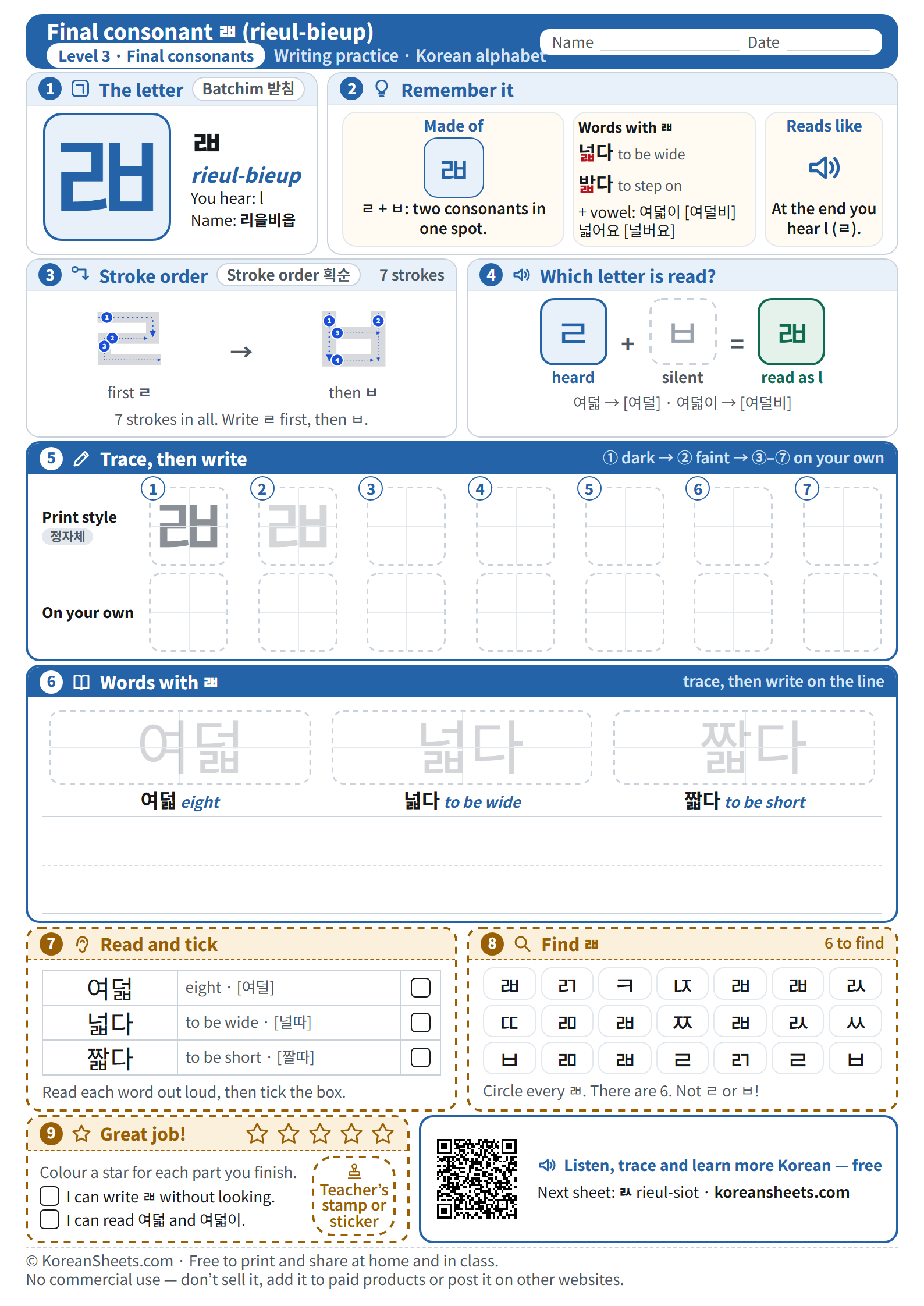
ㄼ writing worksheet (free printable)
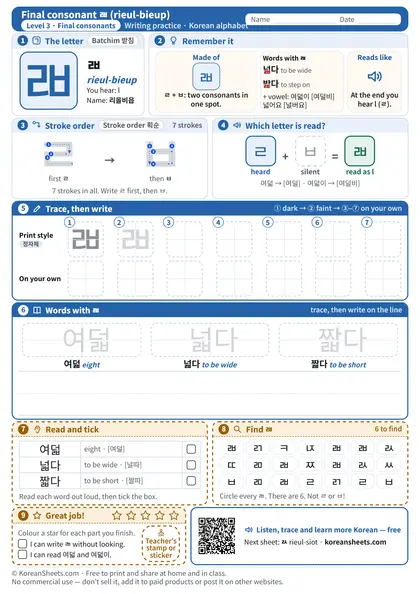
Worksheet · Level 1 · Letters
Korean double final consonant tracing worksheet: ㄼ (rieul bieup)
The one-page rieul bieup ㄼ sheet shows which of ㄹ and ㅂ is read, traces ㄼ, and practises the words 여덟, 넓다, 짧다.
- 1 page
- A4 · US Letter
- PDF · 86 KB
- Free · no sign-up
Want more? Get a printable pack of Hangul letters
Worksheet information
- How to use
- Decide which letter of ㄼ you hear, trace it in 7 strokes, then practice 여덟 and 넓다.
Practice ㄼ
With ㄼ (rieul-bieup), say each word in the table twice, once alone and once with the vowel ending, and listen for the moment the second letter reappears. In the case of ㄼ (rieul-bieup), repeat until the switch from [여덜] to [여덜비] feels automatic.
The worksheet for ㄼ (rieul-bieup) is a single printable page made from the same data as this page: it has the stroke order, tracing rows and a find-the-letter game.
Try it yourself

Put rieul bieup ㄼ, l, into the builder and read the block it makes. Open the syllable builder with ㄼ ready
ㄼ (리을비읍) — FAQ
Which sound does ㄼ make when it ends a syllable?
Only ㄹ is heard, as a short l.
When is ㄼ read with both letters?
Before a vowel the ㅂ moves forward. Examples: 여덟이 is [여덜비], 넓어요 is [널버요], 짧아요 is [짤바요], 얇아요 is [얄바요] and 밟아요 is [발바요].
Why is 밟다 read with a ㅂ when 짧다 is read with a ㄹ?
ㄼ is normally read as ㄹ, as in 짧다 [짤따], but 밟다 is a fixed exception and is read [밥따]. It has to be learned as a word, not derived from the letter.
How many strokes do you need for ㄼ?
ㄼ has seven strokes: ㄹ takes 3 strokes and ㅂ takes 4 strokes.
Last updated: