
ㄶ (니은히읗): the Korean double final consonant
ㄶ joins ㄴ and ㅎ under a vowel. Learn which letter is heard. Hear 많다 alone as 만타 and linked as 마나요; print the free ㄶ worksheet.
What sound does ㄶ make at the end of a syllable?
ㄶ (nieun hieut) is a double final consonant made of ㄴ and ㅎ (hieut), and at the end of a syllable only the first letter, ㄴ (nieun), is heard as a short n. ㄶ is far more common than most other double final consonants, because 많다 (many), 괜찮다 (okay) and 귀찮다 (bothersome) are used every day. A good word to start with is 많다 (to be many): alone it is read [만타], and with a vowel ending 많아요 it is read [마나요].
ㄶ nieun hieut: parts, sound and strokes
ㄶ 니은히읗Korean double final consonant
ㄶ joins ㄴ and ㅎ; at the end of a syllable the first letter, ㄴ, is heard.
ㄶ at a glance
Which sound ㄶ makes at the end
니은히읗ㄶ before a vowel
| Word | Alone | Linked |
|---|---|---|
| 많다 (to be many) | [만타] | 많아요 [마나요] |
| 괜찮다 (to be okay) | [괜찬타] | 괜찮아요 [괜차나요] |
| 귀찮다 (to be a bother) | [귀찬타] | 귀찮아요 [귀차나요] |
Before a vowel the ㅎ falls silent and the ㄴ moves forward: 많아요 is [마나요] and 괜찮아요 is [괜차나요]. Nothing is left of the ㅎ in these forms.
Say 많다 (to be many) on its own first, as [만타], and then 많아요, which is read [마나요]. Say 괜찮다 (to be okay) on its own first, as [괜찬타], and then 괜찮아요, which is read [괜차나요]. Say 귀찮다 (to be a bother) on its own first, as [귀찬타], and then 귀찮아요, which is read [귀차나요].
More forms of ㄶ to listen for
| Form | Reading |
|---|---|
| 많고 | [만코] |
| 많지 | [만치] |
| 많은 | [마는] |
| 많네 | [만네] |
Before ㄱ and ㅈ the ㅎ hands its breath to the next consonant, before ㄴ it simply vanishes, and before a vowel it is silent.
For ㄶ (nieun-hieut), say these forms aloud and compare each reading with the spelling: 많고 [만코], 많지 [만치], 많은 [마는], 많네 [만네].
Think of ㅎ as a breath that is passed along to the next consonant or lost on the way.
Exceptions and special cases for ㄶ
A common slip with ㄶ
Say 많다 slowly as 만 + 타 and notice that the t in 타 is stronger than a normal ㄷ. That extra breath is the missing ㅎ.
How to write ㄶ
Trace nieun hieut ㄶ with a finger, mouse or pen: start at the numbered dot, follow the dotted arrow, and press Clear to try again.
Print style 정자체
Follow the numbers and dotted arrows
Handwriting 필기체
Same stroke order as print style
The two letters inside ㄶ
Where ㄶ sits in a block
Words that use ㄶ
 Words with ㄶ
Each word here uses ㄶ (nieun-hieut) as its final; the table lists the reading and the meaning.
ㄶ among the other double finals
heard: ㄱ
heard: ㄴ
heard: ㄴ
heard: ㄱ
heard: ㅁ
heard: ㄹ
heard: ㄹ
heard: ㄹ
heard: ㅂ
heard: ㄹ
heard: ㅂ
In the case of ㄶ (nieun-hieut), there are eleven double finals in all. ㄳ, ㄵ, ㄼ, ㄽ, ㄾ, ㅀ, and ㅄ are read from the first letter as well, while ㄺ, ㄻ, and ㄿ follow the other pattern.
With ㄶ (nieun-hieut), sorting the eleven pairs into first-letter and last-letter groups turns a long list into two small rules.
ㄶ writing worksheet (free printable)
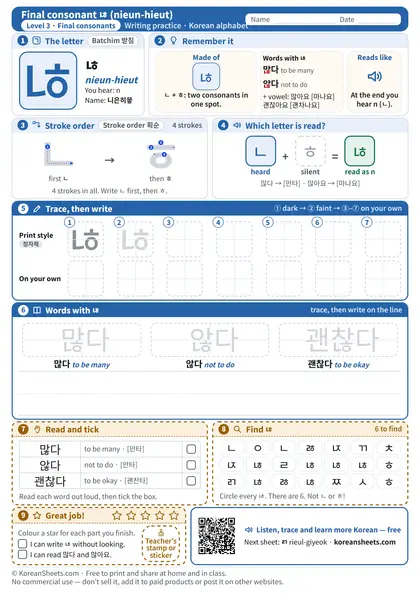
Worksheet · Level 1 · Letters
Korean double final consonant tracing worksheet: ㄶ (nieun hieut)
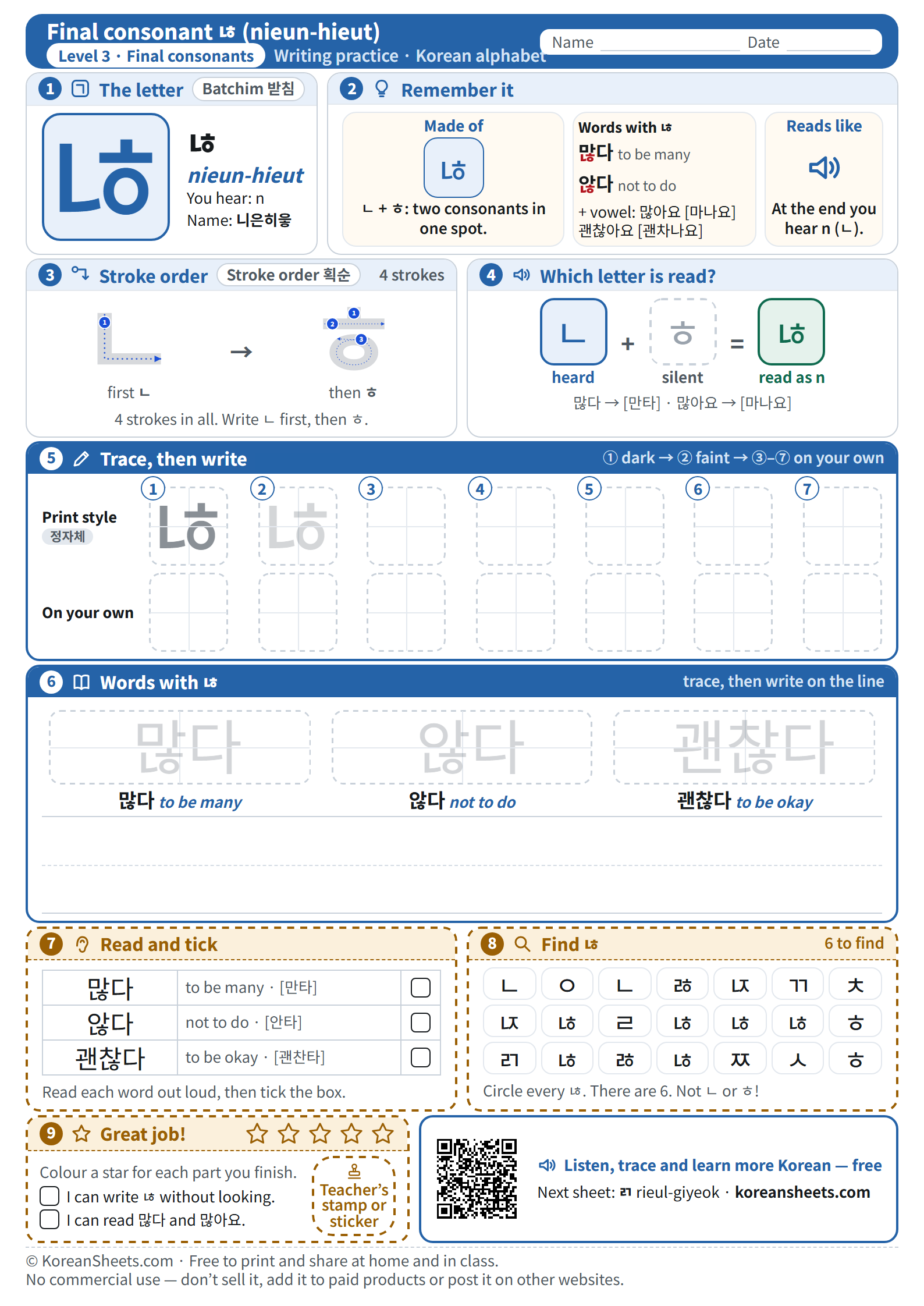
The one-page nieun hieut ㄶ sheet shows which of ㄴ and ㅎ is read, traces ㄶ, and practises the words 많다, 않다, 괜찮다.
- 1 page
- A4 · US Letter
- PDF · 86 KB
- Free · no sign-up
Want more? Get a printable pack of Hangul letters
Worksheet information
- How to use
- Decide which letter of ㄶ you hear, trace it in 4 strokes, then practice 많다 and 않다.
Practice ㄶ
Say each word in the table twice, once alone and once with the vowel ending, and listen for the moment the second letter reappears. For ㄶ (nieun-hieut), repeat until the switch from [만타] to [마나요] feels automatic.
A one-page worksheet for ㄶ (nieun-hieut) sits beside this guide, with the stroke order, space for tracing and a spot-the-letter game.
Try it yourself

Put nieun hieut ㄶ, n, into the builder and read the block it makes. Open the syllable builder with ㄶ ready
ㄶ (니은히읗) — FAQ
Which sound does ㄶ make when it ends a syllable?
Only ㄴ is heard, as a short n.
When is ㄶ read with both letters?
Before a vowel the ㅎ falls silent and the ㄴ moves forward. Examples: 많아요 is [마나요] and 괜찮아요 is [괜차나요].
Why does the ㅎ in ㄶ disappear in 많아요?
A ㅎ between a sonorant like ㄴ and a vowel is not pronounced, so the ㄴ simply links to the next syllable and 많아요 becomes [마나요]. This is why the written ㅎ looks missing in speech.
How many strokes do you need for ㄶ?
ㄶ has four strokes: ㄴ takes 1 stroke and ㅎ takes 3 strokes.
Last updated: